Jim Gianatsis (right) with 3-time World Superbike Champion Troy Bayiss(left) at a Ducati Racing Experience's Troy Bayliss Academy Track Day at the Imola International Circuit in Italy. Jim presents Troy with a copy of Jim and Alan Cathcart's book "Ducati Corse World Superbike"s which features Troy and his Ducati race bikes on the cover and inside. Jim Gianatsis Jim maintained his AMA Pro Racing License while working at Cycle News, but his duties covering the National races on weekends limited his own time to racing at major events, yet he did earn AMA #100 in 1973. When Jim gave up his number, it was next given to former AMA National MX Champion Bob Hannah when Bob returned to racing in 1979 after a year off from breaking his leg.
in conjunction with the Calendars, Jim also produced the annual LA Calendar Motorcycle Show which quickly grew beginning in 1993 to become the longest running privately produced custom and performance streetbike show in America. The Show originally began as an annual 1-day event at the Santa Monica Airport's Museum of Flying from 1993 to 1999, then moved to the larger Queen Mary Event Park in Long Beach, CA , from years 2000 – 2012, expanding into a 2-day weekend with 190 major manufacturers and venders, and some 20,000 paid spectators.
An accomplished author, photographer and publisher, Jim has written and published a numnber of books over the years including the Design & Tuning for Motocross Series first published wheb he worked at Moto-X Fox in the early 1980s, and then revised in later years. He also co-produced the large coffee table book Ducati Corse World Supetbikes with fellow motojournalist Alan Cathcart and photographer Kel Edge. Each year Jim also produces the FAST Calendar Digital Yearbooks featuring behind the scenes storiues on the shooting of the FastDates.com Calendars with detailed features on motorcyles, models and location shoots. And of course, Jim produces and writes the FastDate.com Calendar Website. A reknown freelance motorcycle magazine writer and photogrpher as well, Jim has been published in most all of the leading English pubished motorcle magazines over the years and today including Cycle World, Motorcyclist, Sport Rider, Popular Cycling, Cycle Guide, Cycle, Amerian Rider, Easyrider, American Iron, Hot Bike, Bike Craft, Thunder Press, Dirt Rider, and Racer X.
Jim was working at Moto-X Fox / Fox Shox at the time as Marketing Director and Design Engineer with the development of Fox Shox for motorcycle roadracing, he saw the application of the industry leading Externally Adjustable Fox Resevoir Shox to sports car roadracing as well, and worked with Trans-Am Champion Greg Picket to use Fox Shox on his 1982 Trans Am Championship winning Corvette. From there Fox Resevoir Shox became the staple of all the top factory prototype race cars in the IMSA Roadracing Championship, followed by Indy Car Racing with Rick Mears running Fox Shox on his Pensky Indy car to win the Indianapolis 500 in 1984 and 1988. Jim
Gianatsis - A Personal Biography
|




 |
In August 1969 Jim received a call from Cycle News Dixie managing editor Jack Mangus to move to Atlanta and become their full-time feature editor, which was a dream job come true. Within 6 months Cycle News Dixie had combined with Cycle News East from Ohio, owned by the Claytons, Cycle News East and Cycle News West shared national race coverage and feature articles. |
In 1971 Jim earn AMA National Number 100 as a Pro motocross ride rider, placing 17th at the local Atlanta National MX that year. Jim still continued to race Pro MX on off weekends when not covering races for Cycle News. After Jim retired from AMA motocross his same number 100 would be given to Bob Hannah to recognize the No.1 plate Bob had earned as 250 National MX Champion1978, but never got to use because of a waterskiing injury that broke his leg and left him out of racing nearly 2 years.
Jim's tenure at Cycle News ran four years from 1969 to 1973 as the sport of motocross skyrocketed to popularity in America. His race coverage, newspaper design and photography in Cycle News was done in an editorial style never before seen in the sport, similar to the emerging new Rolling Stone music newspaper.
Boring lap-by -lap race coverage was set aside for the creation of exciting rivalries between up and coming new American motocrossers like Tony D, Bob "Hurricane" Hannah and Marty Smith against the reigning World Champions like Roger DeCoster and Heikki Mikkola. Nicknames including "The Hurricane" "Typhoon Tripes", "Lumberjack" Burgett. "Jammin'" Jimmy Weinert. "Gassin' " Gaylon Moiser and others were created by Jim to elevate the riders to cult status among race fans.
Back then, riders like Hannah, Weinert and Tripes like to say what they felt with no regard for keeping a "clean" promotional image, and Jim would often pose them leading questions to extract controversial comments from them about their rivals to build epic on and off-track rivalries that would go down in motocross history. 1970 to 1980 became the golden decade of motocross history as directed and recorded in print and film by Jim Gianatsis
Sharing in Jim's enthusiasm for the sport and its rise to popularity at that time were Jody Weisel, then editor of Cycle News Central based in Austin, Texas, and freelance photographer Charlie Morey from Palm Beach, Florida. Jody would later become an editor at Cycle News West, and then Motocross Action magazine. Charlie would replace Jim at Cycle News East, and then later Jody at Cycle News West, and then around 1980 become editor of Dirt Rider.
In April 1973 Jim left Cycle News East (which would within a few years merge with the Central and West editions in Long Beach, CA) to go to work as Marketing Director for Husqvarna East in Lorain Ohio. At that time, Husky East was owned by John Penton, and Jim lived in a communal house next door to the Pentons, which was shared by visiting factory riders. Jim lived, practiced and trained with the likes of Heikki Mikkola, Kent Howerton, Marty Tripes and Dick Burleson and other motocross and enduro stars of the time. Jim was involved in the development and testing of new bikes like the Husky Automatic.
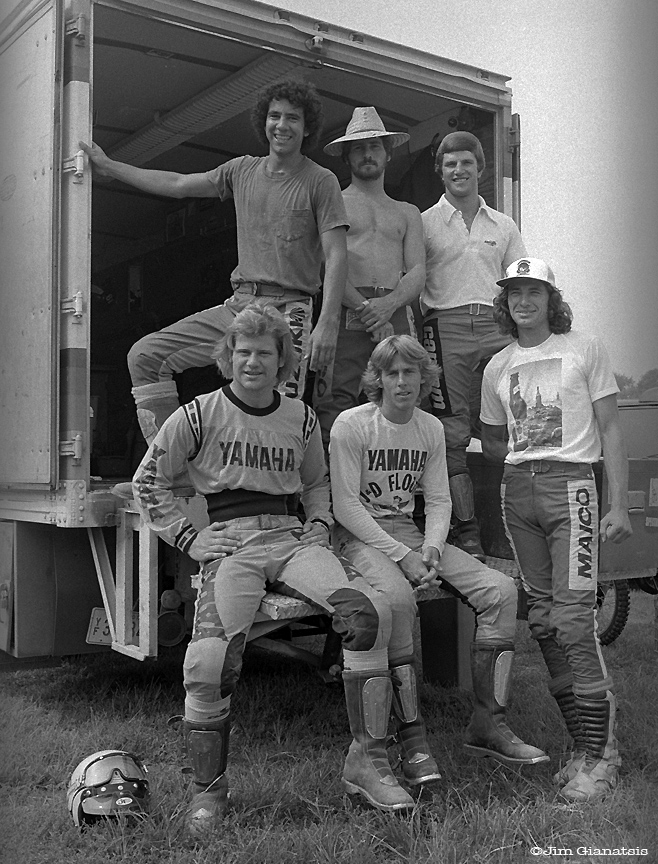
Jim's tenure at Husky East was short lived as within the year Husqvarna of Sweden would dissolve the Eastern office and merge it with Husqvarna West in San Diego. Jim moved back to his parent's home in Biloxi Mississippi, and returned to freelance motocross coverage of all the major national motocross series and events for Cycle News, Motocross Action, Cycle World and others. Much of the time Jim traveled and lived with the factory race teams, the riders and the mechanics, as they traveled across the country to race in box vans and worked on the bikes in hotel parking lots. Jim shared in driving the vans, working on the bikes, and often slept on the hotel room floors of his biddies Bob Hannah and Tony DiStefano.
Being a pro caliber motocrosser, factory test engineer and magazine bike tester, Jim was the only motojournalist allowed to ride and test the exotic factory works bikes of the era including the championship winning YZ250 of Bob Hannah and Marty Smith's RC450, the RM250 Suzuki's of Danny LaPorte and Tony DiStefano. Often Jim was able to provide the younger riders and factory teams with valuable input on the suspension setup and tuning of their bikes.
In late 1979, after 10 years of traveling the national motocross circuit, Jim was turning 30 and thinking it was time to settle down with a full-time job again. He liked the central region of California around San Francisco and had built up a close working relationship with Geoff and Bob Fox, the owners of Moto-X Fox, one of the premier emerging motocross product companies of the time with their Fox Shox and motocross apparel. Jim went to work at Moto-X Fox as their first Marketing Director, assisting Geoff with designing the motocross apparel line, while handling all the advertising and catalog design and photography for the company.
At Motocross Fox, Jim began photographing a featuring attractive models in the Fox Catalog and magazine ads, the first time this was ever done in what was thought of as a "male only" sport. But it made good sense in that guys like looking at pretty girls. It would provide a huge marketing advantage, one that would be copied years later by all the major motocross apparel companies.
With his experience as a test engineer and being a pro motocrosser, Jim also became heavily involved in Fox Shock testing and design. With Jim's inside contacts at the factory motocross teams it wasn’t long before team Honda and other motocross teams were racing with the new Fox Twin Clicker Shox.
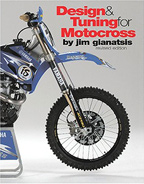
Still racing motocross, Jim suffered a couple of serious injuries in 1981 that regrettably forced his retirement from motocross. He also wrote a book at this time "Design & Tuning for Motocross: published by Classic Motorbooks, which remains today, the only technical book on motocross bikes ever written.
Jim's attention shifted back to the street where he got back into sportbike riding with a Suzuki GS750E, and into car racing with a street legal Camaro Z28 in SCCA Solo II autocross where he clinched runner-up in the highly competitive BP race car class with Trans-Am spec cars.
Jim introduced the new Fox Factory Twin Clicker Motocross Shox to reigning Trans-Am sports car champion Greg Pickett who became running and winning with the Fox Shox on his Corvette which proved to be the best shocks of any type on the market at that time. Within 3 years all the major race teams from Ford in IMSA to Penske in CART were running Fox Shox. Eventually Penske would steal the Fox Shox Design and sell it under his own name.
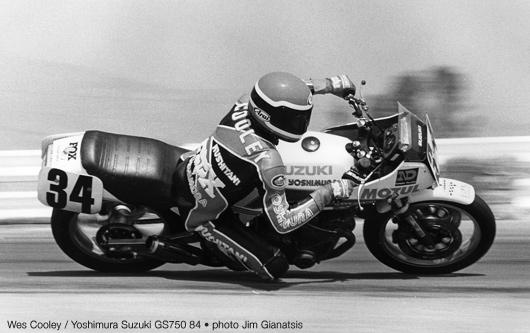
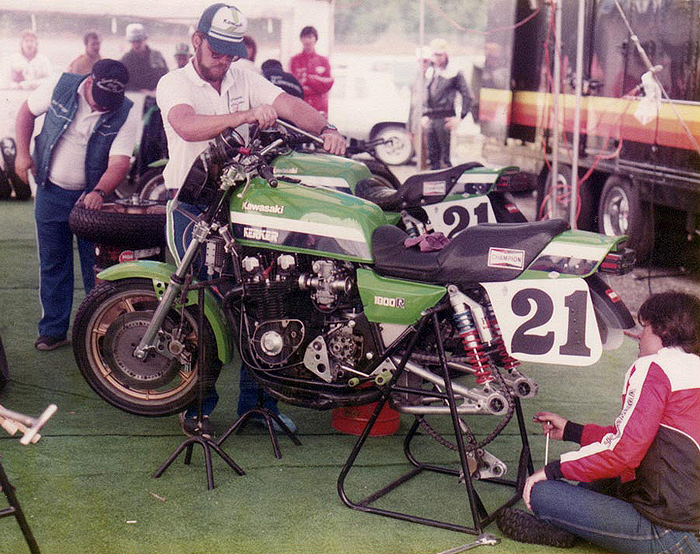
But Jim didn't stop there. Why not introduce the Fox Shoxs to motorcycle roadracing as well? Jim approached and tested with all the major factory roadrace teams including Suzuki, Honda and Kawasaki and within 9 months all the roadracing teams were running Fox Shox that Jim built, test and set up for them Wes Cooley won the 1981 AMA Superbike Championship on his Yoshimura Suzuki Katana 11000, and Eddie Lawson won the 1982 AMA Superbike Championship on his Kawasaki KZ1100, both on Jim Gianatsis prepared Fox Reservoir Piggyback Shox .
In January 1983 Jim had taken Moto-X Fox in just 3 years from 3 million in sales annually to 12 million. And made them the leader in the world motocross and suspension markets. But owner Geoff Fox was wanting to turn over the reins of his company to his wife and children and fired Jim. Within 2 years Fox fell out of the streetbike market and lost their automotive Shock market to Penske.
Jim moved to Los Angeles in the winter of 1983 and began Gianatsis Design Associates, his own advertising, photography and design agency specializing in the motorsports market. Clients included Yoshimura, White Brothers. O'Neal USA, Body Glove and Mikuni Carburetors.
In 1990, first working with client Lee Chapin at Mikuni Carburetors, Jim began expanding both companies' market base with the world’s most popular line of motorsports pinup calendars, initially known as the Mikuni Calendars, then the FastDates.com Calendars and Website. And into event promotion business with the Los Angeles Calendar Motorcycle Show, which started out in 1992 as a barbeque party at his house to celebrate the first release of the first Fast Dates Calendar. Around year 2000 both the Calendars and the Calendar Motorcycle Show had evolved into the most popular motorsports Calendars sold world-wide, become the biggest custom and performance streetbike show in America. The products became too big for Mikuni American to deal with as a partner, and in 2001 the Calendars and the Calendar Show became the exclusive properties of Gianatsis Design.

The Calendars at different times would include some 8 different Calendar titles:; Fast Dates Race Bikes with Swimsuit Models, Iron & Lace Custom Motorcycles with Centerfold Models, Hot Waves Jet Ski Calendar with Swimsuit models, Berm Busters factory Motocross Bikes with Swimsuit Models, Custom Iron Custom Bikes only, Ripped Pavement Action Roadracing, Garage Girls Hard at World, and Cafe Racers.
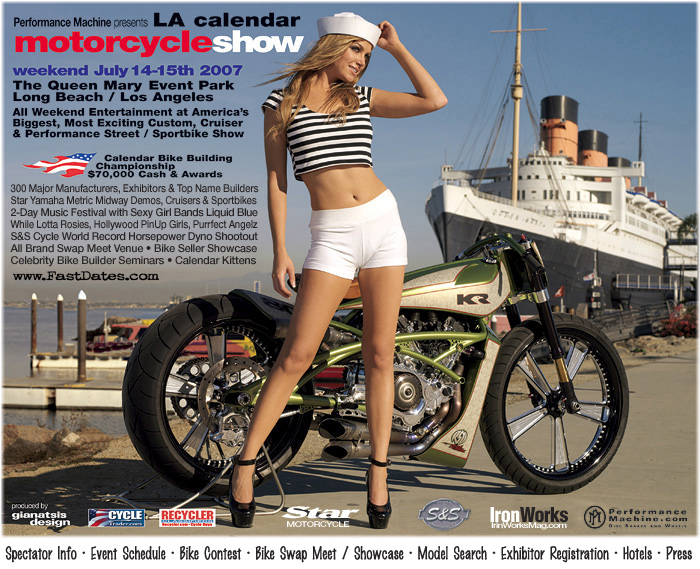
The LA Calendar Motorcycle Show evolved from a 1-day event at the Santa Monica Airport's Museum of Flying from 1995-2000. Then in 2001 as the Calendar Show continued to grow, Jim moved it to the much larger Queen Mary Ship and Event Park in Long Beach, California. By 2003 the Show was expanded to 2-days to accommodate its growth of both spectator and vendors, and even by 1996 event hosted a National Caliber Supermoto Races in the adjoining. parking lot. The mid '90s were the Show's biggest years ever with some 190 major motorcycle and product manufacturers, exhibitors and vendors, and hosting some 4,000 paid spectators per day. Show activities included the now world famous Calendar Bike Building Championship, Calendar Bike Builder Seminars, the Calendar Girl Music Festival with girl performance groups and singer song writers, and the World Record Dyno Horsepower Shootout. As of 2014 the LA Calendar Motorcyle Show has continued as the longest running street motorcycle event on the West Coast of America.

Jim lives
in Woodland Hills, CA, just northeast of Los Angeles in the San
Fernando Valley. He remains a hardcore sports car and sportbike
enthusiast. His cars include a highly modified 650hp Corvette C6 Z06 good for 220mph, the latest BMW M4 Coupe, a modified Mini Cooper S Coupe, and and a classic 1946 MG TC.
Jim's
modified sportbikes over the years once included an array of the best Japan had
to offer (a GSXR750 streetbike Jim built and was test by Motorcyclist
in 1984's bested Eddie Lawson's Rob Muzzy built ZX750 championship
winning AMA Superbike tested by Cycle magazine. Jim's favorite
bike marque today is Ducati and his garage is home to all 5 generations of Ducati Superikes from an 888 SPO,
926R, 996R, 998R Superbikes, 999R 05. 1098R 08, 1199RS Superbikes, and a Multistrada 1200, and an Aprilia Mille R converted to
a Tuono R and a Vespa Scooter.

Jim Gianatsis in the race pits at Misano Italy with World Supebike Champion Troy Bayliss and Ducati Italian National Champion and Ducati Racing Experience head instructor Dario Machetti for an excluise Troy Bayliss track day aboard Ducat's then
new 1199S Panigale.
Going into the 21st century, Jim got hooked on motorcycle riding in beautiful Western Europe and would go on Edelweiss World Tour rides every other year, including bike trips crossing through the Alps, Itly, Germany and France. And taking the Ducati produced Ducati Racing Experience track days at at the legendary European Grand Prix of Imola and Missano with one of his favorite racers, 3-time World Superbike Champion Troy Bayliss.
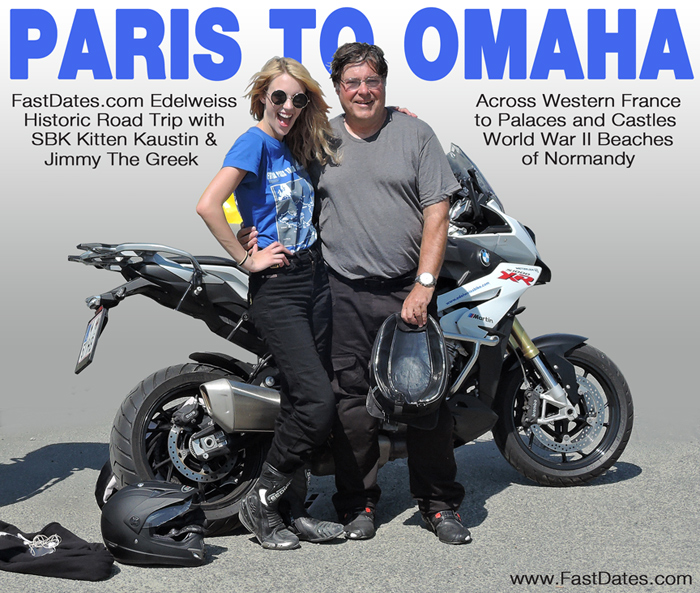
Most recently in 2016 Jim rode the Edelweissi paris to Omaha tour across Western France with his model, SBK World Superbike girl and Penthouse Pet Kaustin Rose, stopping at the historic World War II Beaches of Normandy where his father, B26 bomber pilot James Gianatsis helped take out the German coastal guns on D-day morning to open the way for the Allied Invasion of Europe.
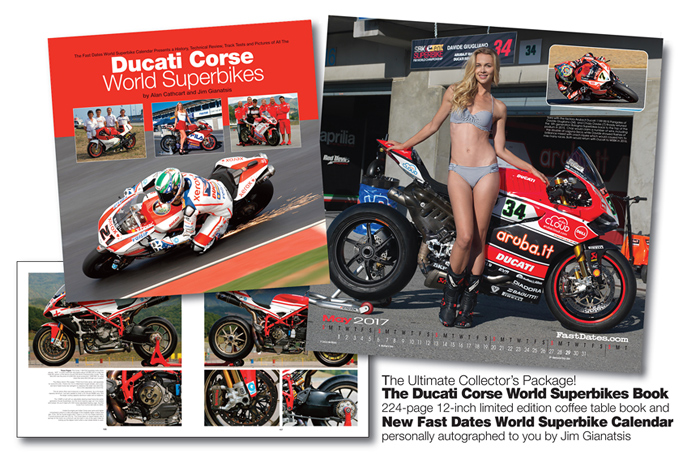
Jim wrote and co-authored in 2012 with famed motorcycle journalist Alan Cathcart, the 224-page coffee table book
" Ducati Corse World Superbikes". Click Below to order.


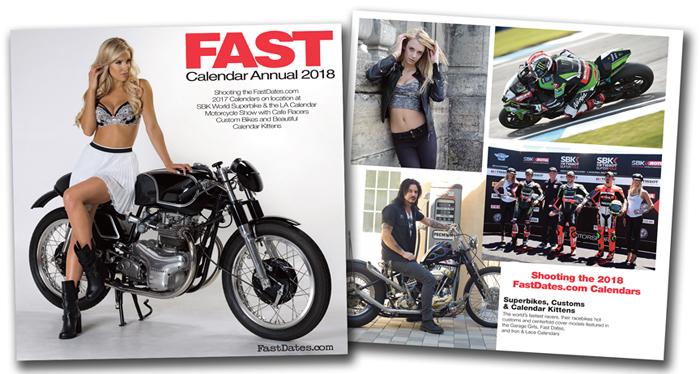
Above: Jim on location at 2013 Laguna Seca World Superbike with FastDates.com Calendar Kittens Jessica harbour, Hannah Flattery and Halie Arbaugh. Below, Jim's Fast dtes calednar Shoot at Laguna Seca Worls Superbike and the 2014 LA Calendar Motorcyel Show.

To Still Be Continued . . . .
JIM "THE GREEK" GIANATSIS SAYS GOODBYE TO CYCLE NEWS,
AND JODY WEISEL RELATES HIS NOT-SO-FOND MEMORIES:
Two of Cycle News most famous alumni tell what it was like to work at Cycle News in the glory days of the 1970s; Different views of the same.
January 2012 - Here is an editorial that Jody Weisel and I wrote about the death of Cycle News 2 years ago. Cycle News did return to life again about 6 months ago, under new ownership by the MAG Group, owner of many well known motorcycle product companies. The new Cycle News is all digital, it looks really good visually, but it has no advertising to support it and it continues to mix top level motocross and roadracing - which you can't do any more in this digital / speciality age and survive, with no other motorcycle content or industry news to make it really interesting. I just don't see how it will survive unless the owners Mag Group are willing to accept the bleeding cash loss and are using it to market their own product brands.
August 14, 2010 - THE OFFICIAL PRESS RELEASE: Cycle News has ceased publication (at least for now) as of Tuesday. August 31. We wish to thank all of our loyal readers and supporters, many of which have been with us for 40 years and more. The people and the companies in the motorcycle industry and sport have been great partners and soul mates for these many years and we have all "grown up" together. We hope to find a new owner to carry on this iconic publication and we thank you in advance for your future support if we are successful. Again, our heartfelt thanks for all your support.

FORMER CYCLE NEWS EDITORS AND FAMOUS MOTO-JOURNALISTS
JIM GIANATSIS & JODY WEISEL SAY GOODBYE TO CYCLE NEW PRINT
"I was with Cycle News almost from the beginning. Sharon and Chuck Clayton started what would become Cycle News West from their home office from in Long Beach, California, in the mid 1960s and they quickly expanded it across the United States by buying up other regional motorcycle monthlies.
"I was 19-years-old college drop-out working at a local Yamaha dealer in 1968 in my hometown of Biloxi, Mississippi, and had my first new motorcycle in years, a Yamaha CT175 which I was racing on the weekends in everything from TT scrambles, to motocross, to road racing (on a 1/2 mile banked asphalt stock car track on Saturday nights in nearby Mobile). I had one set of spoked wheels with Continental street bike tires for road racing, then late Saturday night after the stock car race night, I bring my bike back to the shop and convert it back over to knobbies for motocross on Sunday morning.
"One of my hobbies had always been photography, and since I was also shooting at the races I started covering the local races for Dixie Cycle News based out of Atlanta. Within a year I had turned AMA Pro motocrosser, moved to Florida to work at a couple of Yamaha shops there, and was racing in the Florida Winter-Am Series with guys like Gary Bailey and Barry Higgins, while also sending in race coverage and tests of new dirt bikes to Dixie Cycle News.
"In the summer of 1969 the Clayton's decided to consolidated two Eastern newspaper they had recently purchased, Motorcyclist's Post out of Lorain, Ohio, edited by Todd Rafferty and Gary Van Vhoories, together with Dixie Cycle News. Both papers merged under the new title of Cycle News East based in Tucker, Georgia, under the editorship of Jack Mangus, a dirt track enthusiast from Maryland and friend of Triumph dirt tracker Gary Nixon. Jack immediately phoned me in Florida and asked me to come on board as the paper's resident motocross specialist. About the same time back in California at Cycle News West under the Claytons, a skinny arrogant kid named John Ulrich was hired on as editor there.
"Once I arrived at Cycle News East I quickly found my job was much more than covering the races. Along with production artist Carol O'Neal we were responsible for the entire production of the paper, which at that time was done by paste-up, using hot wax to burnish down the word type and halftone photographs to the cardboard page boards. Carol also did all the newspaper's typesetting from hand written or typewriter generated copy. I was also the photo lab guy responsible for the processing of all the newspaper's raw film, proof sheeting it, then making the selected photo prints and then using them to make the paper half-tones for paste up on the pages.
"My editorial duties included writing one to two feature articles during the week, which could have been a bike test and racer interview. And on weekends I would fly across the country to cover all the major AMA National, Trans-AMA's and Supercross races East of the Mississippi.

The Greek in the trenches covering a Motocross National circa 1975.
"Cycle News West covered the Western region events. And around 1972 the Clayton's bought up another regional publication in Austin, Texas, where another motocross racer, Jody Weisel, was the editor—it became Cycle News Central. When either Jody or I covered a National in our area we had to carry two camera's and shoot three sets of film, one for each of the three Cycle News regions. Then Sunday night after the races we'd drive our rental car back to the nearest airport on Sunday night and put the film on planes to Los Angeles, Austin and Atlanta to be picked up the next morning. We also had to write our race story on the airplane that night as we flew home, as it had to be done by 9 a.m. that Monday morning so it could be teletyped to the other two offices as well. This was all before the days of email, faxes and Federal Express.
"Mondays were always the most hectic day at all three editions of Cycle News as we had to have the papers completed by that evening for delivery to each of our regional printers on Tuesday morning, where they would be printed and mailed out to subscribers on Wednesday for Friday delivery. So, even after covering a Trans-AMA races at Unadila in upstate New York just the day before, I'd be back into Atlanta on a plane by midnight, catch five hours sleep and show up at our Cycle News office by 8 a.m. Monday to finish up the paper. We usually work there to 10 p.m. at night to finish up the paper, a good 14 hour day. On nights like this when the office worked late, we'd chip-in for beers and chips and we'd be getting pretty loose and crazy. One of the other editors (to be nameless here) lived off a whiskey bottle all week, which he kept stashed in his desk drawer.
"After Monday's late nighter to finsih up the paper, I'd come right back to the Cycle News East office on Tuesday morning at 8am to drive the finished newspaper on paste boards up to Athens, Georgia, (60 miles away) where our printer was located. I'd stay the day as the paper was plated and printed, doing a press check and bringing finished copies of the paper back to the office before closing. I usually drive Cycle News East senior editor Jack Mangus' 1969 Pontiac GTO up to Athens and back on the narrow two-lane, moonshiner, wooded back roads with the speedometer hovering around 100 mph. I wore out his classic 8-track tape of the Who's ”Who's Next” album blasting full volume as I raced down the 2-lane backroads like a Georgia Moonshine runner!"
"I usually worked 60 to 100 hours a week at Cycle News East in the office and traveling across the Eastern USA to cover the major races and loved it. It was a dream job, working, writing, photographing and hanging out with the best motorcycle racers in the world at the heyday of the sport in America. Sharon Clayton made us sign 40 hour week time cards so we couldn't ever come back and sue her for unpaid wages if we ever got fired. Jack Mangus and I wanted at one point, to evolve Cycle News into the feature style of the then-hugely popular Rolling Stone music newspaper, and I'd like to think East took the lead among the three Regions—despite not being located in the motorcycle capital of Los Angeles. I wanted to evolve Cycle News beyond just race coverage.
"At some point in time all the good editors at Cycle News would get fired, hired away to a glossy print motorcycle magazine, or burn out. I got fired. Mangus fired me in November 1982 in a little spat over my not wanting to cover both a Trans-AMA race on a 20 hour weekend and also help Van Voorhis shoot a 2 hr late night AMA Dirt Track Saturday Night National that same weekend in Cincinnati - while working the Trans-AM motocross both days alone, myself.
"Within a few months I moved to Ohio to work for John Penton, who owned Husqvarna East at the time, as their Marketing Director. I was there for a year, but was then let go when Husqvarna of Sweden decided to takeover ownership of the U.S. distributorships and move them to Tennessee. That year 1973 at Husky East was a really cool job living in a guest house next to the Penton famiy, sharing the house with touring Husky motocross stars like Heikki Mikkola, Kent Howerton, Marty Tripes and the Penton and Husky ISDT team riders. I was also good friends with National Motocross and Enduro Champion Dick Burleson.
Weekdays we might all be riding or testing together out at the local Meadowlarks Motocross Track.
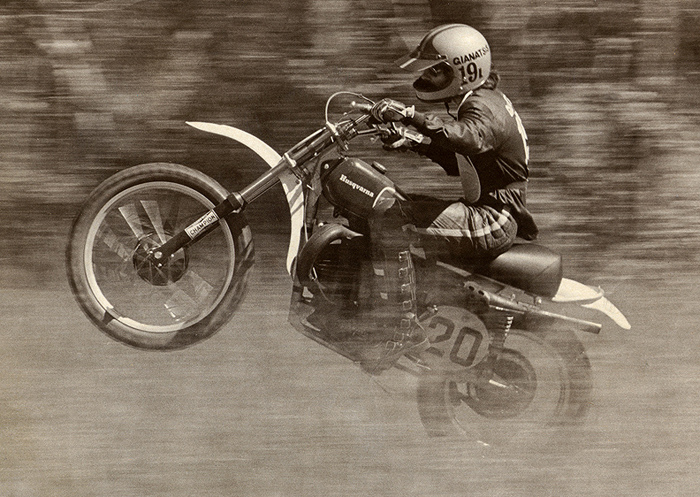
Above: Racing my Yamaha DT1 in 1971 at a sand track in Florida. Right; Testing new Husqvarna bikes at the Meadowlarks track in Lorain, Ohio. |
 |
"In following years when I was now a Cycle News Contributing Editor covering the races across America, I'd always stop back and stay at the Penton guest house when passing through northern Ohio. During that time I owned and raced both 250cc Huskys and Pentons and got to race a lot of the cool race tracks like the Trans-Am track at Lexington Ohio..
"When I returned to covering most of the National motocross and Trans-AMA races and doing feature articles for Cycle News on both coasts as a freelance editor. I also became close friends with all thetop factory and privateer riders including Tony DiStefano and Bob Hannah and traveled the circuit with them and their mechanics in their factory box vans, or in my own Ford E250 Econoline Van.
"Once I made a non-stop record run from Los Angeles to Daytona in 36 hours. The teams often stopped over at my parent's house in Biloxi on the Gulf Coast, where I was based at the time, to rebuild their race bikes on the front lawn between trips to and from Daytona. I covered all the major motocross races, tested bikes and wrote feature stories for Cycle News up through 1980, at which point I went to work full time for Moto-X Fox in San Jose, California, as their product designer and marketing manager.
"During the mid 1970s Cycle News, with their three editions, was probably the most important motorcycle publication in America with around 50 employees. Cycle News was sold on the parts counters of every motorcycle shop in America.
"In 1976 all three editions were merged together at Cycle News West with Jody Weisel and Jack Mangus moving there to take over the reigns. John Ulrich went to work for Cycle World, and later started his own newspaper Roadracing World which would rival Cycle News for that sport's segment.
"Cycle News was still the news source for motorcycle racing in America up through the year 2000. It filled a need in the sport that lasted until the Speed TV Channel emerged to cover racing in the 1990s. Still the Japanese bike distributors poured tens of thousands of dollar in advertising revenue into Cycle News each month to tout their race wins over each other, or their newest bikes—just as a matter of company pride
"Then the internet came into its own around year 2000 and the handwriting was on the wall. Now all the race organizations from AMA to World Superbike and MotoGP had their own press offices and websites to report their races. This was soon followed by the race teams themselves getting their own press officers to offer team coverage as well. Anyone with a motorcycle website could offer just as detailed race coverage as Cycle News.
"When the US economy started its down turn three years ago, the motorcycle distributors saw their sales drop as low as 50%, all their advertising budgets ran dry, particular for Cycle News— which was now down to a claimed 30,000 readers a week.
"Could Cycle News have survived the current economic crises if it had done something different? Hard to say. Losing the advertising revenue of the major motorcycle manufacturers was a huge blow. But they still could have survived if they could have stopped focusing on racing-only coverage where they could no longer compete with TV and the internet. Instead they needed to evolve 20 years earlier as mainstream motorcycle weekly newspaper like England's still hugely successful MCN Motorcycle News. They needed to cover other major non-racing motorcycle events like Sturgis and the EIMCA Show in Milan. Both Sharon Clayton and most recent editor Paul Carruthers were too set in their ways. They didn't want to change until it was already too late." - Jim Gianatsis

FORMER CYCLE NEWS CENTRAL AND CYCLE NEWS WEST EDITOR JODY WEISEL
SAYS SOMETHING UNEXPECTED
Jody at Mosier Valley before his Cycle News days. Check his knuckles to see how close the trees were to the track back in 1973.
"I was a motorcycle racer from Texas and I did a lot of test riding during the formative days of American motocross. I was buddies with two famous Cycle News photographers, Richard Creed and Dennis "Ketchup" Cox. They both worked for Cycle News and would often ask me to ride test bikes for the photos. I liked doing it and I liked being on the cover of Cycle News...it was the motorcycle version of the cover of Rolling Stone. What I didn't like was the tests that the Cycle News editors wrote to go along with the bikes I rode. I told them that I could do a better job and they agreed. So, I rode for the photos and I wrote the tests...but I didn't work for Cycle News. I was just riding the bikes for photos. One day they ask me if I would like to be the editor of Cycle News Central (as Jimmy "The Greek" said, there were three Cycle News back then). Richard Creed was moving to California to take over Cycle News West and I was to fill his shoes. I loved Cycle News Central and all the goofballs that Ketchup and I hung out with in Austin, Texas. We had a blast. We raced at Whitney, Rockhart, Mosier Valley, Strawberry Hill, Rio Bravo and Pecan Valley and basically treated Cycle News Central as our own play toy.

Jody Weisel on the cover of Cycle News in September, 1974, before he started working for them.
"Then something bad happened...very bad.
"Richard Creed had gone off to cover the Sturgis Rally and decided that he wanted to stay there. He married a local Sturgis girl and took over the town newspaper. Creed was the greatest photographer I ever met—but he wasn't marriage material. I don't know what happened to him. But, back to the bad part. With Creed leaving, Cycle News West needed editors who raced motocross...Ketchup and I were the only two editors who raced dirt bikes (the Greek raced, but he was on the road 40 weekends a year). Ketchup and I didn't want to leave Texas, but Sharon Clayton was going to close Cycle News Central down and merge it with the West...so we were out of a job any way. I told Ketchup to go to SoCal (where he would run the photo lab) and I negotiated to get to do the complete 1975 Trans-AMA Series before moving to California. Sharon was over a barrel, so she agreed. Tony D, Keith McCarty, Brian Lunnis, Billy Grossi, The Greek and I had a grand time on the road for ten weeks.
"Suddenly, the honeymoon was over. Once the Trans-AMA ended at Saddleback I was at the corporate offices and I hated it. I grew over time to distrust the people in charge. Sharon Clayton appointed some horse's patoot to run the company for her...his name was Bob something. In my humble opinion, he was an arrogant imbecile who was basically spending Cycle News money while making terrible decisions. Founder Chuck Clayton wasn't around much during my time at Cycle News West—but when he did come down from Malibu he was spacey. He had some wacky ideas about publishing that we resisted with all our might. I loved Chuck as a person, but when people would tell me that Chuck Clayton was a genius who was ten years ahead of his time, I would say, "Yes, he is, but his time was 1950."
"Cycle News was a dysfunctional place to work at and I wanted out of there within a month of the 1975 Trans-AMA ending. Luckily, I got five job offers from the motorcycle monthlies looking for editors who raced...I analyzed all the offers and chose the smallest magazine of the bunch—Motocross Action. It was a magazine about motocross and that was all I cared about. Plus, I would get total control—no moron in a suit ruining the hard work. I came to Cycle News West in January of 1976 and I left in December of 1976. I never looked back and I'm not misty about my time at Cycle News West...but I am about the glory days at Cycle News Central.
"And here is the kicker. A couple weeks ago, Ron Lawson of Dirt Bike was telling me that Cycle News was going out of business. I told him that it seemed inevitable because they had made a ton of bad decisions (dropping local coverage, going to glossy paper, focusing on road racing and losing their shop circulation) and I told him my story about Cycle News management, saying that, 'When I was at Cycle News 34 years ago Sharon Clayton hired some boob to run the company into the ground. His name was Bob something.'
"Lawson started laughing and said, 'Yeah, that's the same guy who runs it now.'
"I won't miss Cycle News. Sorry, you probably wanted some tear jerker story from me about how great the grand old paper was. Here it is—I loved the people I worked with—Mike Klinger, Ketchup (who by the way came with me to MXA when I left Cycle News), Bob Dickey, Richard Creed, the Greek, Lane Campbell and all the contributors. I just didn't like the people I worked for."
- Jody Weisel
I worked at Moto-X Fox from 1979 to 1982 as Advertsing Designer and Marketing Manager.
The Moto-X Fox Story 1974-1989

Los Angeles, USA
4801 Reforma Road • Woodland Hills, CA 91364 USA
Phone: (01) 818.223.8550 • Facsimile: (01) 818.223.8590
email: JGDesign@FastDates.com Gianatsis Design Associates: Page 1 Introduction • Page 2 Graphic Design • Page 3 Photography
• Page 4 Press / New Product Release Services • Page 5 Advertising & Marketing Services • Page 6 Web Design
• Page 7 FastDates.com Advertising Rates / Gianatsis Design Service Rates
Page 8.1 Classic MX & Stock Motorcycle Images 01 • Page 8.2 Stock Images 02 • Page 9 The Jim Gianatsis Story
FastDates.com Calendar Distributor Information • FastDates.com Webmaster Affiiliate Programs
|
Legends of Motocross
1976 500cc World Motocross Champion Roger DeCoster.
Paige Brooke and celebrity builder Exile Cycle's Russell Mitchell's Discovery Channel Custom Build Off Bike. Commercial Stock
|